Panther’s zAccounts: Get started with Panther


Table of Contents:
zAccounts leverage Panther’s privacy-preserving architecture to enable confidential transactions and serve as the gateway to entering Panther Protocol. On this blog, we explain what a zAccount does and how it interacts with Panther’s Multi-Asset Shielded Pool (MASP).
What is a zAccount
A Panther zAccount is a private, onchain identifier that acts as a secure gateway to confidential DeFi transactions. Through the zAccount, users can satisfy compliance requirements, hold zAssets—Panther's privacy-enhanced representations of deposited assets—and participate in confidential transactions within Panther:
- Creation & Activation: Users connect their externally-owned account (EOA), complete compliance requirements through approved third-party providers, and activate their zAccount. These requirements may include identity verification, wallet risk screening and other eligibility checks. A unique zAccount ID is registered in a public lookup table maintained by Panther’s smart contracts.
- Root Keys: Each zAccount is tied to two root public keys—one for spending and one for reading. These enable secure access to zAssets while keeping operations shielded.
- UTXO Integration: zAccounts are implemented as special UTXOs (Unspent Transaction Outputs), which represent individual spendable records, in append-only Merkle trees. Every zAsset UTXO is assigned to a specific zAccount owner via unique spending keypairs. This ensures only the rightful owner can spend assets, while non-interactive transfers allow seamless, private peer-to-peer movement.
This architecture delivers:
- Unlinkability: External observers can’t easily connect your trades back to your Externally Owned Account (EOA).
- Non-Interactive Transfers: Send zAssets privately to another zAccount holder using their public read/spending keys from the registry.
How zAccounts interact with Panther’s MASP
zAccounts strike a powerful balance between privacy and real-world usability, allowing privacy and compliance to coexist within the same infrastructure. Panther’s zAccounts interact with the MASP when users swap assets, mint them within the shielded pool, and withdraw them.
- Deposit & Mint: Link your EOA, activate your zAccount, and deposit assets to mint zAssets inside the shielded pool.
- Private Trading: Use zSwap via DeFi adaptors—all tied to your zAccount and bundlers. External observers can not directly link the swap to the user´s identity or EOA.
- MEV Protection & Alpha Safeguarding: Trading strategies, position sizes, and timing remain hidden, reducing the risk of front-running and strategy replication.
- Withdrawal: Redeem zAssets back to your EOA or another address, with full user control.
- Rewards & Fees: Certain activities within Panther may earn Panther Reward Points (PRPs), a non-transferable internal rewards mechanism that encourages participation and helps strengthen the protocol's privacy set. Users can also manage gas and protocol fees directly from their zAccount balances.
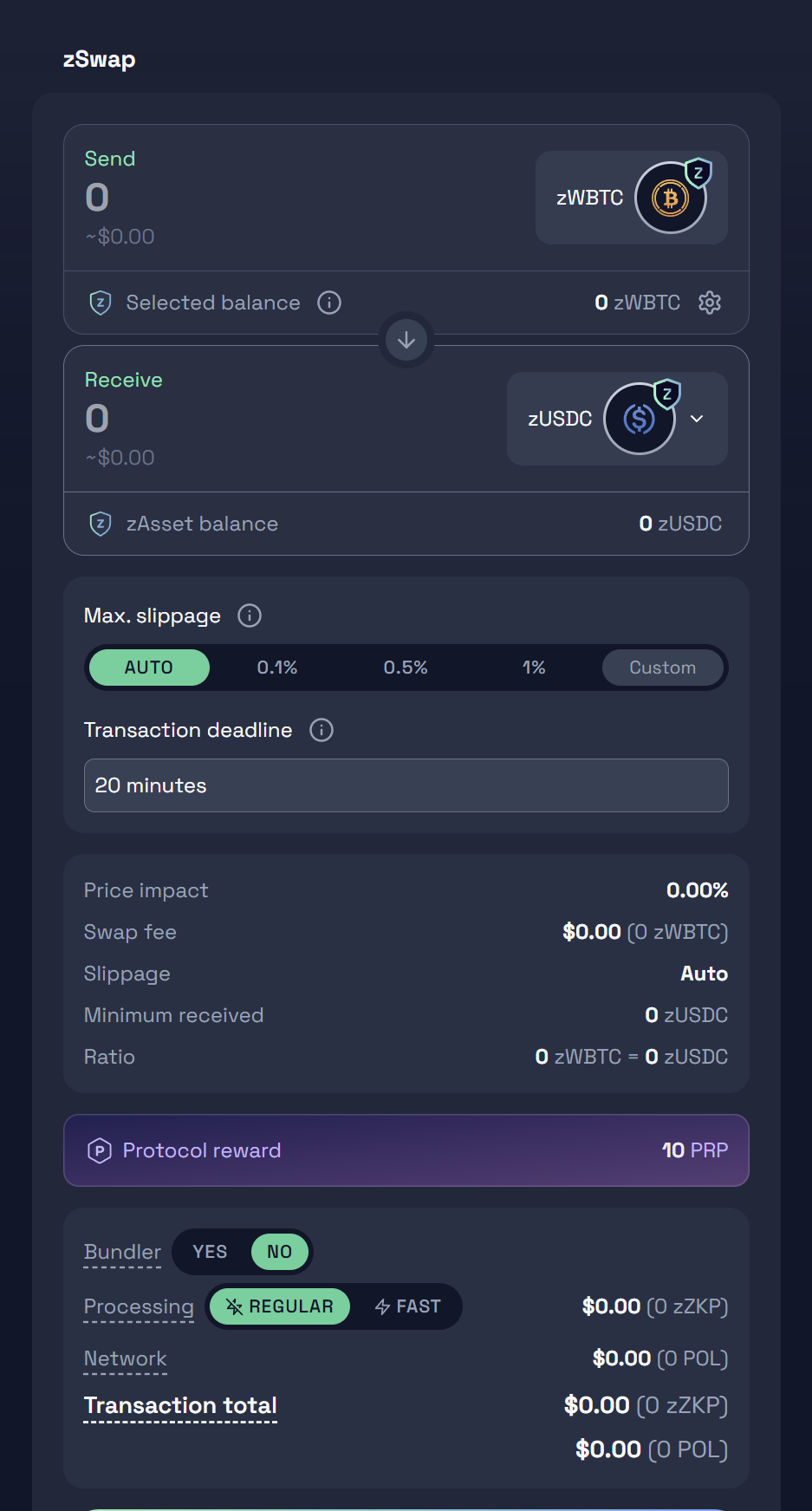
Zone Managers define entry rules, but once inside, users enjoy strong anonymity sets shared across the pool—making individual transactions harder to distinguish. Unlike fully anonymous mixers (which face regulatory hurdles) or transparent DEXs, zAccounts enable programmable privacy—strong defaults with flexible compliance hooks.
Getting Started with Panther
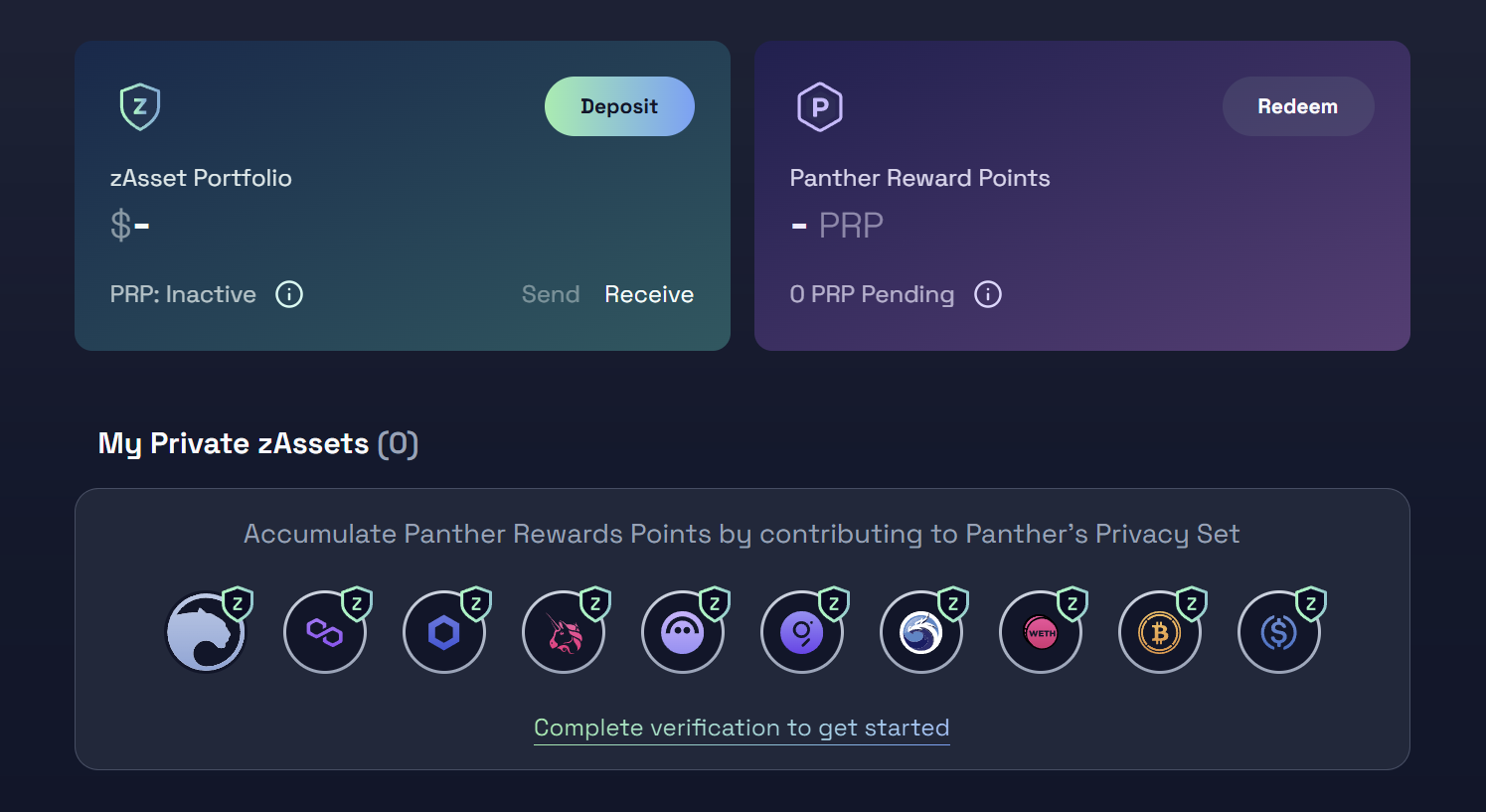
Panther’s DAO-operated shielded pool can be accessed by visiting the Panther dApp (pantherdao.app or equivalent interface). Users can also find the dApp link on the pantherprotocol.io website and in the bio of Panther Protocol’s official X account: https://x.com/ZKPanther.
To access the DAO-operated shielded pool, users have to:
- Connect their wallet.
- Generate two public keys.
- Complete the required compliance attestation.
- Activate their zAccount to begin depositing/minting zAssets.
Panther Protocol enables independent, third-party compliance providers to handle user verification and regulatory checks without the protocol itself storing or processing private user data. Compliance providers like PureFi issue cryptographic credentials after verification, allowing users to generate zero-knowledge proofs in their browsers to prove compliance without revealing underlying personal data. Panther Protocol itself remains agnostic, and Zone operators could select their own compliance provider for users to gain access. Always review the latest updates, as features and compliance measures evolve through the Panther DAO.
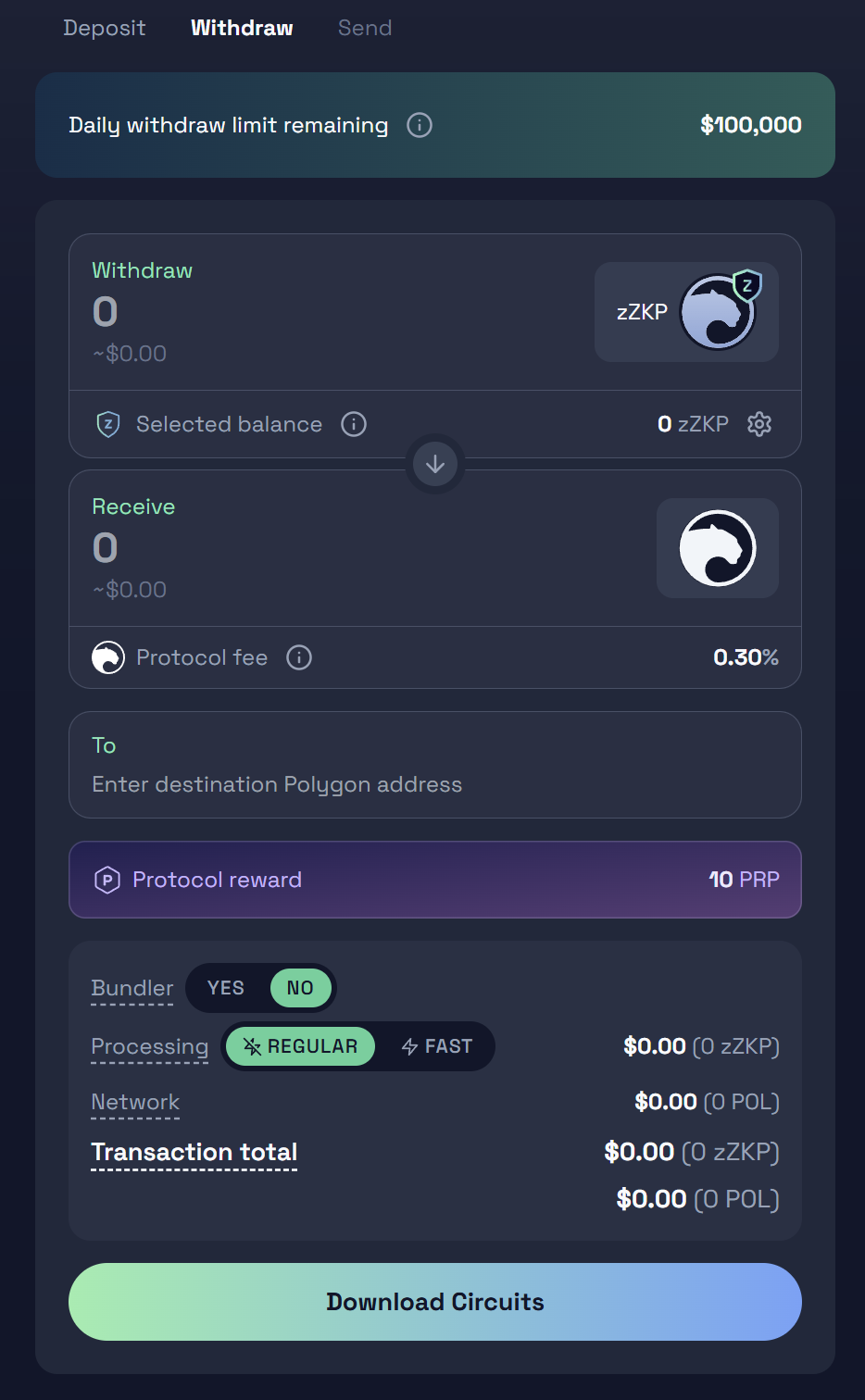
To interact with Panther Protocol smart contracts via the dApp, users must first download Panther’s zero-knowledge circuits and related client-side components. Panther’s zk circuits run locally in the user's browser or application environment. As decided by the Panther DAO, the daily deposit limits are $25,000 and withdrawal limits are $100,000.
The Future of Private Ledgers
zAccounts represent a mature evolution in privacy tech: not all-or-nothing anonymity, but user-controlled confidentiality supported by compliance mechanisms and designed to integrate seamlessly with DeFi. As Panther expands across different EVM-compatible chains, zAccounts will power the next wave of sophisticated, privacy-first onchain finance. Panther´s zAccounts are built not only to enhance user privacy but also to align flexibly with the intricate demands of decentralized finance and operators.
About Panther Protocol Foundation
Panther Protocol Foundation is a non-profit organization supporting the Panther ecosystem through research, ecosystem funding, software stewardship and open-source development.
The Foundation does not operate the Panther protocol, host deployments, custody assets, execute or intermediate transactions, or provide financial services.
The proprietary Panther dApp is licensed by the Foundation to support independent ecosystem deployments.
Users interact directly with smart contracts from their own wallets, signing every transaction themselves. Compliance credentials are issued and managed by independent third-party providers.
Please review the applicable notices, disclosures and jurisdictional restrictions available through the Panther interface before interacting with the protocol.
For more information, visit panther.org
To learn more about Panther Protocol, visit pantherprotocol.io