Programmable Privacy: How Panther Enables Customizable Confidential Trading Environments


Table of Contents:
In decentralized finance (DeFi), transparency is both a strength and a limitation. Every transaction on a public blockchain is permanently visible, enabling auditability and trustless verification while also exposing trading strategies, wallet relationships and financial activity. For institutions, businesses and privacy-conscious users, this lack of confidentiality remains a significant barrier to broader adoption.
Panther Protocol addresses this challenge through programmable privacy: confidential trading environments that combine zero-knowledge cryptography with configurable access controls and compliance policies. Rather than treating privacy as an all-or-nothing proposition, Panther allows operators to determine how privacy should function within their own trading environment, balancing confidentiality with regulatory or commercial requirements.
The Problem: Transparency Without Boundaries
Public blockchains record the sender, recipient, asset and amount of every transaction indefinitely. While this transparency underpins decentralized finance, it also creates practical challenges:
- Front-running and Maximal Extractable Value (MEV) attacks that exploit publicly visible transactions.
- Wallet clustering and transaction analysis by blockchain analytics providers.
- Exposure of trading strategies, treasury movements and commercial relationships.
- Reluctance from institutions and high-net-worth individuals to transact on fully transparent networks.
Many privacy protocols attempt to solve these issues by removing visibility altogether. While effective from a technical perspective, this approach often leaves operators with little flexibility to implement their own compliance or access policies.
Panther takes a different approach. Privacy remains the default, but the rules governing participation are configurable by the operator.
The Solution: Configurable Shielded Pools
At the heart of Panther Protocol are shielded pools—confidential trading environments where users deposit supported assets and receive corresponding zAssets, confidential representations backed 1:1 by collateral held within a Panther Vault.
Within a shielded pool:
- Transactions are protected using zero-knowledge proofs, preventing observers from linking deposits, transfers or withdrawals to individual users.
- Multiple digital assets and asset types coexist within the same pool, strengthening the overall anonymity set through diverse pool activity.
- Assets remain fully collateralized and can be redeemed for their underlying assets, subject to the rules governing the relevant pool or Zone.
Panther's architecture draws inspiration from privacy-focused systems such as Zcash while being purpose-built for Ethereum Virtual Machine (EVM)-compatible blockchains and decentralized finance.
The Technical Foundation
Panther combines several cryptographic components to deliver confidential transactions.
zk-SNARKs
Zero-Knowledge Succinct Non-Interactive Arguments of Knowledge (zk-SNARKs) allow users to prove that transactions are valid without revealing the underlying transaction data. This enables confidential transfers while maintaining cryptographic integrity.
Merkle Trees
Append-only Merkle trees maintain the private state of the protocol. Users prove ownership and spendability of their Unspent Transaction Outputs (UTXOs) using zero-knowledge proofs without revealing the UTXOs themselves.
zAssets
zAssets are confidential representations of deposited assets. Each zAsset is backed by collateral locked within a Panther Vault and can later be redeemed for the corresponding underlying asset.
zAccounts
Within Panther, users interact through zAccounts, which are represented using UTXOs rather than externally owned account (EOA) addresses. This allows users to exchange zAssets privately without revealing their wallet addresses or linking their activity to publicly visible blockchain identities.
Programmable Privacy Through Zones
A key differentiator of Panther Protocol is its Zone architecture.
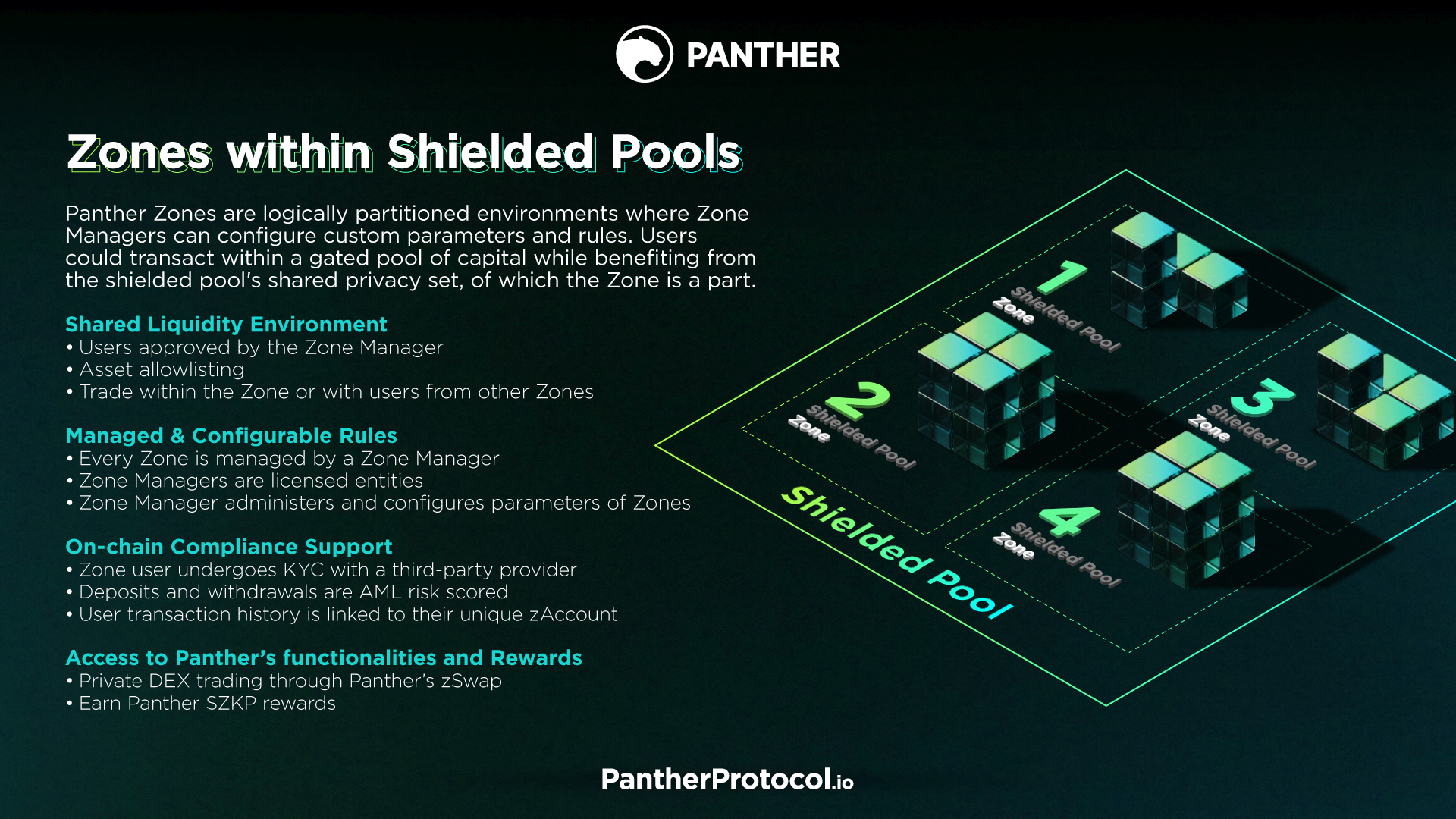
A shielded pool can be divided into logical partitions called Zones, each managed by a Zone Manager. A Zone Manager might be a regulated virtual asset service provider (VASP), decentralized autonomous organization (DAO), financial institution or other authorized operator.
Each Zone can define its own policies, including:
- Allowlisted assets.
- Allowlisted participants.
- Entry requirements, including Know Your Customer (KYC) verification through approved compliance providers.
- Transaction limits.
- Geographic restrictions.
- Cross-Zone trading permissions.
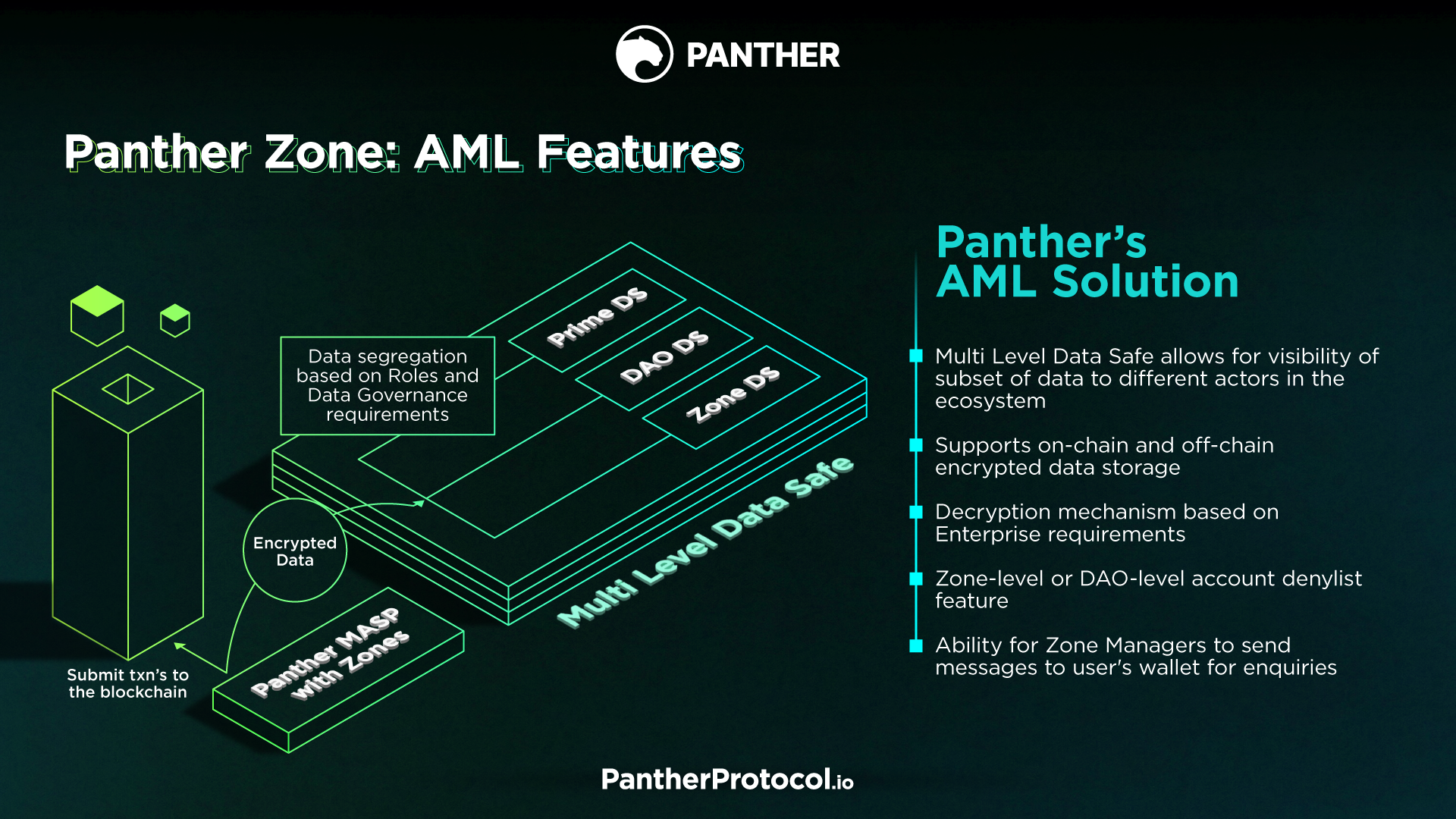
- Sanctions screening and address blacklisting.
Importantly, although each Zone applies its own participation rules, all Zones within the same shielded pool contribute to a shared anonymity set. Users therefore benefit from increased privacy generated by activity across the entire shielded pool while interacting only with assets and counterparties permitted within their own Zone.
This allows operators with very different requirements to coexist within the same privacy infrastructure.
For example:
- A regulated exchange may require full KYC and transaction monitoring.
- An institutional over-the-counter trading desk may restrict participation to approved counterparties.
- A DAO treasury may permit only governance-approved participants and assets.
Each operator applies its own policies while benefiting from the same underlying confidential infrastructure.
Flexible Deployment Models
Operators can deploy Panther in different ways depending on their objectives.
Some may choose to manage a Zone within an existing shielded pool deployed by the Panther DAO. This allows them to leverage infrastructure maintained by the DAO while retaining control over the policies governing their own confidential trading environment.
Others may choose to operate an entire shielded pool themselves, providing greater control over infrastructure, governance and fee generation.
This flexibility enables Panther to support a broad range of institutional, commercial and community use cases.
Configurable Compliance
Panther does not process or store users' personal information. Instead, operators select the compliance providers and policies appropriate for their own deployment.
Available compliance mechanisms include:
Data Escrow
Data Escrow enables governed, conditional disclosure of encrypted metadata under predefined circumstances, allowing operators to support investigative or regulatory requirements without compromising routine user privacy.
Know Your Transaction (KYT)
Operators may integrate Know Your Transaction (KYT) services for wallet screening, sanctions screening and deposit or withdrawal controls.
Where supported by the selected compliance provider, extended KYT capabilities may also include ongoing transaction monitoring, suspicious activity monitoring and Travel Rule reporting.
Zero-Knowledge Know Your Customer (KYC)
Users complete KYC with an independent compliance provider before generating a zero-knowledge proof confirming that they satisfy the operator's requirements.
The operator receives confirmation that the user meets the applicable policy without Panther Protocol learning or processing the user's underlying personal information.
Current Status
Panther Protocol was deployed to Polygon mainnet in May 2026, introducing live programmable privacy infrastructure governed by the Panther DAO.
Development continues with ongoing protocol enhancements, wallet improvements, governance evolution and additional deployments, including support for Base.
As the ecosystem expands, Panther aims to provide a confidentiality layer that can support a wide variety of operators while giving users greater control over the visibility of their on-chain activity.
Conclusion
Privacy and compliance do not need to be mutually exclusive.
Panther Protocol demonstrates how confidential on-chain trading environments can coexist with configurable operational and regulatory requirements. By separating confidentiality from policy, Panther enables operators to define their own participation rules while benefiting from shared privacy infrastructure.
The result is programmable privacy: confidential trading environments that can be adapted to institutional, commercial or community requirements without sacrificing the privacy that public blockchains have historically lacked.
About Panther Protocol Foundation
Panther Protocol Foundation is a non-profit organization supporting the Panther ecosystem through research, ecosystem funding, software stewardship and open-source development.
The Foundation does not operate the Panther protocol, host deployments, custody assets, execute or intermediate transactions, or provide financial services.
The proprietary Panther dApp is licensed by the Foundation to support independent ecosystem deployments.
Users interact directly with smart contracts from their own wallets, signing every transaction themselves. Compliance credentials are issued and managed by independent third-party providers.
Please review the applicable notices, disclosures and jurisdictional restrictions available through the Panther interface before interacting with the protocol.
For more information, visit panther.org
To learn more about Panther Protocol, visit pantherprotocol.io