Confidential Stablecoin Transfers: How Panther Enables Programmable Privacy


Table of Contents:
Stablecoins are transforming how value moves across blockchain networks. They enable near-instant, low-cost transfers around the clock and have become a cornerstone of decentralized finance (DeFi), supporting payments, lending, trading and settlement across multiple ecosystems.
Because stablecoins allow capital to move continuously, privacy becomes increasingly important. Businesses, institutions and individuals require the ability to transact confidentially without sacrificing the composability and liquidity that make DeFi attractive.
Panther Protocol addresses this through programmable privacy. Its Multi-Asset Shielded Pool (MASP) enables confidential stablecoin transfers while allowing operators to define their own access controls and compliance requirements. Rather than requiring issuers to launch dedicated privacy-focused stablecoins or entirely new blockchain networks, Panther enables existing stablecoins to be used confidentially within the DeFi ecosystems where liquidity already exists.
Why Now?
Stablecoin adoption has accelerated rapidly. Stablecoins now settle approximately US$5.2 trillion each month, have a combined market capitalization of around US$312 billion, and are used by more than 135 million active blockchain addresses. Yet despite this growth, fewer than 0.01% of stablecoin transfers in 2025 were confidential.
This lack of privacy limits broader adoption.
Without confidentiality:
- transactions can be front-run;
- trading and treasury strategies can be analyzed and copied;
- businesses expose commercially sensitive payment flows;
- institutions struggle to execute large transactions discreetly; and
- users permanently expose their financial activity on public blockchains.
If decentralized finance is to support a broader range of commercial and institutional use cases, confidentiality will become an increasingly important part of its infrastructure.
Why Privacy Matters
Protecting Commercial Information
Businesses increasingly use stablecoins for supplier payments, treasury management, payroll and cross-border settlement. Public blockchains expose transaction values, counterparties and payment flows, allowing competitors to infer pricing, commercial relationships and strategic activity.
Protecting Individual Privacy
Anyone with knowledge of a wallet address can analyze its transaction history, balances and spending patterns. Because blockchain data is immutable, that financial history remains publicly accessible indefinitely.
Supporting Institutional Adoption
Financial institutions, market makers and corporate treasuries require operational confidentiality. Public visibility of trading activity and treasury movements can expose investment strategies, increase market impact and reduce execution costs.
Enabling Configurable Compliance
Privacy need not come at the expense of compliance. Zero-knowledge cryptography enables transactions to remain confidential while allowing operators to implement appropriate Know Your Customer (KYC), Know Your Transaction (KYT) and anti-money laundering (AML) controls.
Privacy Without Leaving DeFi
Competition between stablecoin issuers continues to intensify, yet few wish to build entirely new privacy-focused blockchains or dedicated privacy infrastructure.
Panther offers an alternative.
Rather than creating new privacy stablecoins or separate Layer 1 or Layer 2 networks, issuers and operators can enable confidential transfers using existing stablecoins while remaining within the DeFi ecosystems where users, liquidity and applications already exist.
Operators can:
- define which stablecoins and other digital assets are supported;
- determine who may participate;
- configure compliance requirements and transaction policies;
- whitelist counterparties and assets; and
- create confidential trading environments without fragmenting liquidity.
By providing privacy at the smart contract level, Panther allows operators to concentrate their activity where liquidity already exists rather than asking users to migrate elsewhere.
Confidential Stablecoin Transfers Through Panther
Panther enables confidential transfers through its Multi-Asset Shielded Pool (MASP).
Users deposit supported stablecoins into the shielded pool and receive corresponding zAssets—confidential representations backed 1:1 by collateral held within a Panther Vault.
Transfers between zAccounts remain confidential, preventing external observers from linking senders, recipients or transaction amounts while maintaining cryptographic integrity.
Unlike asset-specific privacy systems, Panther's MASP supports multiple digital assets within the same shielded pool. Stablecoins, utility tokens and other supported assets all contribute to a shared anonymity set, strengthening privacy for every participant.
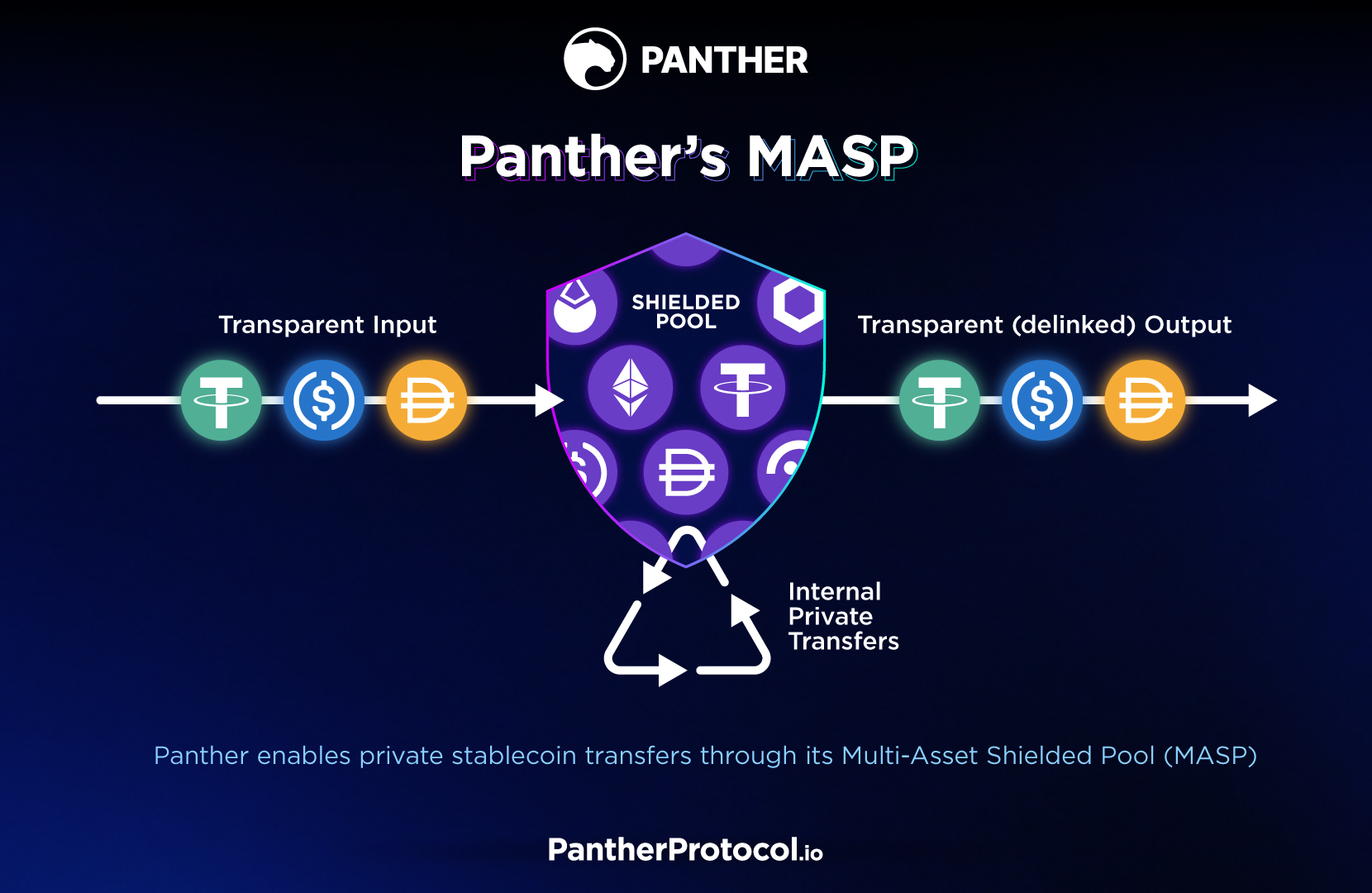
For example, confidential representations of USDT, USDC, DAI and other supported digital assets can coexist within the same shielded pool, alongside other approved assets, subject to the policies defined by the relevant operator.
How Panther Enables Confidential Transfers
Panther combines several complementary technologies to deliver confidential stablecoin transfers.
zk-SNARKs
Zero-Knowledge Succinct Non-Interactive Arguments of Knowledge (zk-SNARKs) allow users to prove that transactions are valid without revealing the underlying transaction data.
zAccounts
Users transact through confidential zAccounts rather than directly exposing their externally owned account (EOA) wallet addresses, helping prevent public linkage between blockchain identities and private activity.
UTXOs
Panther represents balances using Unspent Transaction Outputs (UTXOs). Ownership of these UTXOs changes during confidential transfers without revealing the underlying transaction details.
Panther's split-and-join mechanism helps minimise fragmentation by maintaining efficient UTXO management.
Merkle Trees
Append-only Merkle trees maintain the private state of the protocol. Users prove ownership and spendability of their UTXOs using zero-knowledge proofs while keeping the underlying data confidential.
zMiners
zMiners perform confidential computation off-chain, generate zero-knowledge proofs and submit those proofs to Panther's smart contracts for verification.
Relayers
Relayers further enhance privacy by submitting transactions on behalf of users. They bundle transaction requests, pay gas fees and broadcast transactions without revealing the relationship between the original user and the blockchain transaction.
A Flexible Privacy Layer
Panther is designed to support a broad range of operators.
A regulated financial institution may require comprehensive compliance controls and approved counterparties.
A stablecoin issuer may wish to create a confidential settlement environment around its own token.
A decentralized autonomous organization (DAO) may prioritize governance-based access controls.
Each operator can define its own operational policies while benefiting from the same underlying confidential infrastructure and shared privacy set.
Conclusion
Stablecoins have become one of the most important building blocks of decentralized finance, but widespread adoption increasingly depends on confidentiality.
Without stronger privacy protections, decentralized finance risks becoming a financial system where every transaction is permanently visible and easily analyzed.
Panther enables existing stablecoins to be used confidentially without requiring new privacy-focused stablecoins or separate blockchain networks. Through its Multi-Asset Shielded Pool, configurable compliance framework and programmable privacy architecture, Panther enables operators to create confidential trading environments while continuing to leverage the liquidity and applications of today's leading DeFi ecosystems.
About Panther Protocol Foundation
Panther Protocol Foundation is a non-profit organization that supports the Panther ecosystem through research funding, open-source development grants and ecosystem initiatives.
The Foundation does not operate the protocol, host user interfaces, custody assets, execute transactions or provide financial services.
Users interact directly with blockchain smart contracts from their own wallets and remain responsible for their own activities and decisions.
For more information, visit www.panther.org.
To learn more about Panther Protocol, visit www.pantherprotocol.io.