Panther’s Automated Market Maker - Everything you need to know.


Table of Contents:
Now that Panther’s DAO-operated Mainnet deployment is near, it is time to take a closer look at how its Automated Market Maker (AMM) works! On this blog, we explain the role of Panther’s Reward Points (PRPs) and how their conversion to $ZKP works. We explain the conversion model's calculations, the factors that influence the PRP/$ZKP ratio, and why there is an Automated Market Maker in the first place. Let’s dive in!
What are PRPs and their role?
PRPs are rewards earned for holding shielded $ZKP (zZKP) in Panther’s Multi-Asset Shielded Pool (MASP) and for performing certain user actions within the protocol. zAssets like zZKP are digital assets within Panther’s MASP, in this case, $ZKP tokens within the protocol. Originally, PRPs were intended to be exchanged for zZKP determined by supply and demand once Panther’s Mainnet was operational. However, this has changed as there won’t be a transition from Panther’s MASP v0.5 (also known as Advanced Staking) to Mainnet (v1.0), nor a corresponding upgrade of v0.5 PRPs to v1.0 PRPs. Instead, there will be a floating rate starting at 10 PRPs for 1 $ZKP through the AMM, whereas 1 zZKP is equivalent to 1 ZKP – distinguishing it from the prior PRP exchange mechanism.
Automating claims and user involvement through the AMM
In the current setup, PRPs can be redeemed by exchanging them for $ZKP from the protocol's reserves. Each redemption reduces the $ZKP reserves while Panther users receive $ZKP. On the Limited Mainnet Beta version of Panther’s Mainnet, daily additions (e.g., approximately 33,300 $ZKP per day) significantly affected the PRP and $ZKP reserve balances, thereby influencing the ratio. In contrast, Panther’s Canary environment initially lacked a recharge AMM pool feature, which can skew the ratio by introducing large amounts of ZKP without a corresponding inflow of PRPs.
As there is no way to automate the claiming process, it must be performed manually by PRP holders through the AMM. This design encourages active participation and aligns with the protocol's decentralized nature.
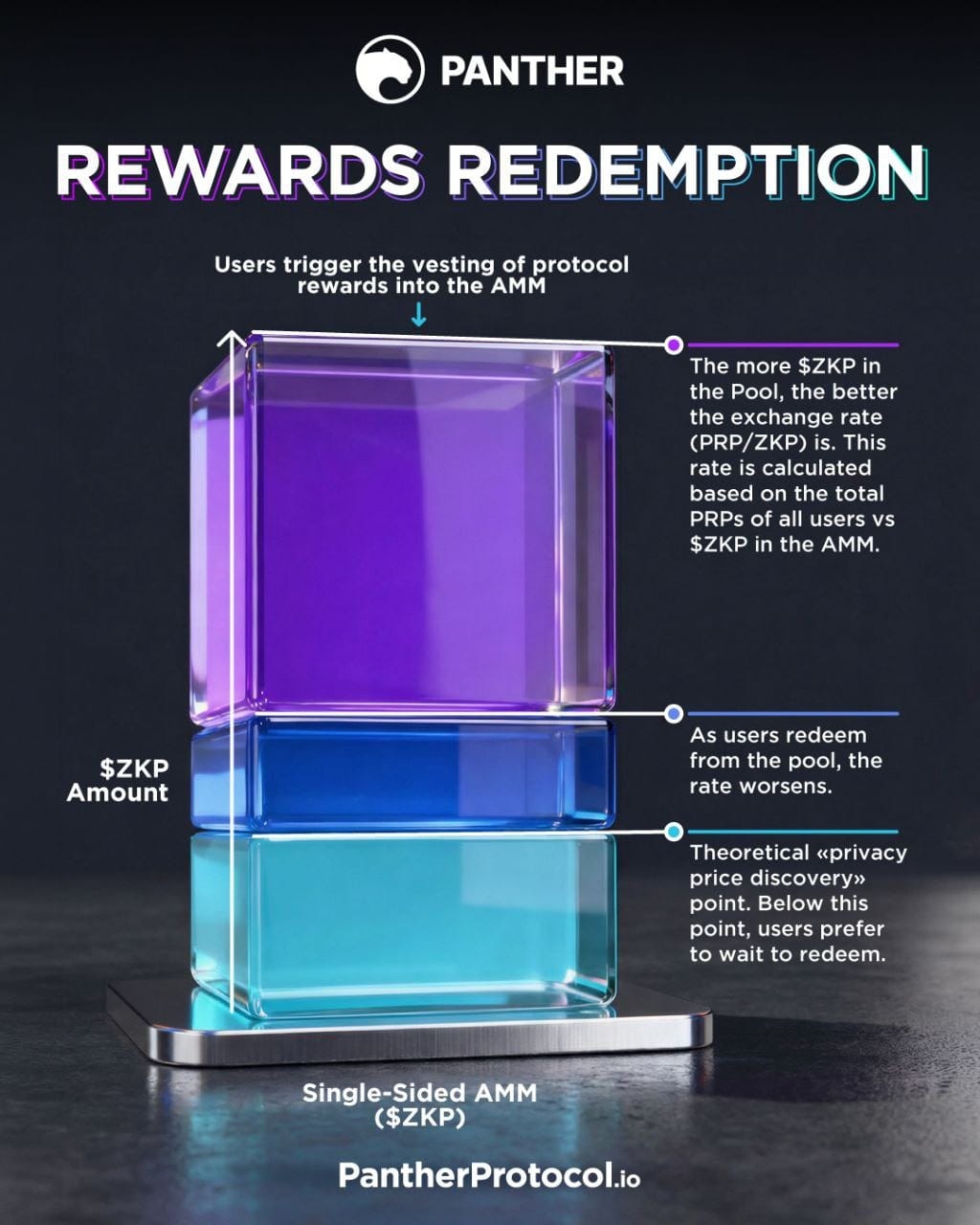
How the AMM conversion ratio is calculated
Panther’s rewards functionality operates on a specific logic for issuing rewards, which has implications for the PRP-to-$ZKP conversion ratio. When protocol rewards are deposited, the reward controller first sends the total accrued amount to the Automated Market Maker (AMM), which can lead to a high initial conversion ratio. To manage this, options include depositing the accrued amount and claiming it to align with current values, or redeploying the smart contract to reset the start date. The $ZKP amount a user receives when redeeming PRP is determined entirely by smart contracts, with no modifications made by the development team. The Panther dApp retrieves this amount, displays it, and calculates the displayed ratio. If a user has no PRP available to redeem, the conversion ratio shows as 0 PRP = 0 $ZKP.
Panther’s smart contracts use the following formula for the PRP to $ZKP conversion:
zkpOut = (prpIn × zkpReserve) / (prpReserve + prpIn)
Where:
- prpIn: Amount of PRP being converted.
- zkpReserve: Total ZKP in the pool.
- prpReserve: Virtual PRP balance in the pool.
- zkpOut: ZKP tokens received.
The rate is then zkpOut / prpIn.
Whereas an example calculation would be:
- Pool state: 1,000,000 PRP reserve, 500,000 ZKP reserve.
- Converting 1,000 PRP:
- zkpOut = (1,000 × 500,000) / (1,000,000 + 1,000) = 500,000,000 / 1,001,000 ≈ 499.5 ZKP.
- Rate = 499.5 / 1,000 = 0.4995 ZKP per PRP.
These calculations depend on the user's available PRP and the current zkpReserve and prpReserve balances, which update with every redemption or AMM pool recharge. This means the $ZKP amount and ratio are recalculated dynamically for all dApp users on the Redeem PRP page.
Factors Affecting the Ratio and Potential Solutions
The PRP-to-$ZKP ratio could become unfavorable due to low user participation—specifically, few users consistently adding significant PRP to the ZKP reserves. In scenarios with only a handful of users (e.g., up to three) redeeming and recharging sequentially in production, the ratio can fluctuate dramatically, for example, 1 PRP = 30 ZKP (as seen in certain screenshots from testers). However, with dozens or hundreds of users engaging 24/7—recharging the AMM pool and redeeming PRP at rates they find favorable—the ratio should stabilize and not spike excessively. To address unfavorable ratios, solutions like a buffer mechanism could be considered if they prove effective and secure.
About Panther Protocol Foundation
Panther Protocol Foundation is a non-profit organization dedicated to supporting the growth, sustainability, and responsible use of Panther Protocol. While it does not operate the protocol or facilitate digital asset services, the Foundation plays a critical role in promoting adoption, supporting open-source development, advancing research, and raising awareness around the protocol’s core privacy-preserving technologies.
By empowering users, developers, and permissioned actors within DeFi and web3, the Foundation contributes to building a more secure and confidential digital future.
For more information, visit www.panther.org
To learn more about Panther Protocol, visit www.pantherprotocol.io.
Contact
Panther Protocol Foundation
📧 Email: general@panther.org
🌐 Website: www.panther.org