Panther’s economic flywheel for privacy: the productive role of $ZKP


Table of Contents:
Privacy infrastructures need an economy that encourages users to use the system in ways that improve everyone else's privacy. This article explains why privacy infrastructures need their own economy, how Panther’s approach differs from earlier privacy-incentive models, and what role $ZKP plays in Panther’s economic design.
Panther has built an incentive mechanism that links protocol activity, reward issuance, and $ZKP redemption inside the same architecture. Panther uses Panther Reward Points, or PRPs, to account for activity that contributes to the health of the privacy set. Users can redeem PRPs for $ZKP through Panther’s Automated Market Maker (AMM).
In short, Panther’s flywheel works like this: users perform actions that make the anonymity set more useful, such as depositing, transacting, and interacting with applications from inside the shielded environment. Those actions can earn PRPs. PRPs can be redeemed for $ZKP through Panther’s AMM. At the same time, protocol activity generates fees, including those paid in supported assets, and the protocol automatically converts these fees back to $ZKP on DEXs to replenish the rewards pool. More useful activity can, in turn, support more rewards, and those rewards can encourage more useful activity.
The bootstrapping problem in privacy protocols
Privacy on a public blockchain is a network effect. It is a constant battle against onchain surveillance tools and analysts. If a shielded pool only has a few users, it offers less privacy. A larger pool, with more users, more assets, and more frequent activity, gives each transaction a larger set to hide in.
This is, in a nutshell, the bootstrapping problem for shielded pools. Cryptography alone is not enough; realized privacy also depends on how many people use a shielded pool, the amount of assets entering and moving through it, and whether activity is frequent enough to make timing analysis less reliable.
Bootstrapping a large enough anonymity set is not only a marketing or UX problem but also an economic-design problem. Users often need privacy intermittently. They may want to make a sensitive transfer, protect a trading strategy, receive salary privately, or move assets without exposing all their data. At other times, they may leave funds on transparent rails because that is where most applications and liquidity are.
If a privacy protocol does not create a reason for users to keep assets within the shielded pool, make transactions, and interact with applications, the anonymity set could remain smaller and less active than the protocol’s cryptography would ideally support or than what the ecosystem would aim for. Panther’s design addresses this challenge by rewarding actions that contribute to the anonymity set.
What a shielded pool needs to be useful
Several factors influence the size of a shielded pool’s anonymity set.
- Pool depth matters because a larger set of shielded assets increases the number of possible sources for a transaction.
- Activity matters because a static pool can leak information through timing. A pool that sees regular deposits, transfers, swaps, and withdrawals gives outside observers fewer simple correlations to rely on.
- Fresh inflows matter because a pool that stops receiving deposits could potentially become easier to analyze over time. As old positions are spent or withdrawn, the effective anonymity set could become smaller even if the historical pool size seems large.
- Asset composition also matters. A multi-asset shielded pool can support more flexible private activity than a single-asset shielded pool, especially where asset types and interactions are abstracted in a way that makes simple asset-in/asset-out matching less reliable. That said, asset diversity does not automatically mean every asset contributes equally to every other asset’s anonymity. Popular and frequently used assets tend to contribute more to practical privacy than assets with little activity.
In Panther’s case, the effective anonymity set is also conditioned by Zones, supported assets, transaction limits, and compliance rules. Panther’s economic design can encourage activity within the protocol, but the practical privacy set still depends on the actual configuration and usage of each environment.
The economic question is therefore straightforward: how should a protocol reward actions that increase the privacy set's size, fresh inflows, and activity?
Three approaches to privacy-protocol incentives
Different privacy protocols have approached protocol incentives in different ways. The point of comparison is not that one model is universally right and another is wrong. Each design optimizes for a different objective.
A useful way to compare them is to ask: what activity is being rewarded, who receives the reward, and how is that reward funded or priced?
Tornado Cash: fixed-duration anonymity mining
Tornado Cash introduced one of the earliest serious attempts to reward users for contributing to an anonymity set. Its Anonymity Mining program allowed users to earn Anonymity Points, or AP, based on how long eligible notes remained in the Tornado Cash pools. AP was accrued privately and could later be converted into $TORN through a custom AMM. This was an important design because it recognized that privacy-set contribution should be rewarded without forcing users to reveal the details of their deposits.
The model was simple and innovative for its time. A fixed allocation of $TORN was distributed to the anonymity-mining program over a defined period. Users with AP effectively competed for the $TORN available through the AMM at the time of redemption.
The limitation here was that the incentive program was finite and externally scheduled. The reward supply did not automatically expand or contract based on ongoing protocol usage. Once the program ended, the anonymity-mining incentive did as well.
Tornado Cash, therefore, provided an important precedent: privacy-set contribution can be rewarded privately, and a custom AMM can be used to convert internal reward accounting into a public token. Panther builds on that insight, but extends it into a broader activity-incentive model.
Railgun: governance and security rewards
Railgun takes a different approach. It does not primarily reward users for depositing into or transacting within the privacy set. Instead, Railgun charges shield and unshield fees, which are collected by the decentralized governance treasury and distributed over time to eligible $RAIL stakers through Active Governor Rewards.
This is a coherent governance-security design. It rewards $RAIL stakers for remaining engaged with protocol governance and code-change processes. That has value for a privacy system, because governance participation can help protect the integrity of smart contracts and treasury-controlled components.
The trade-off is that the reward path is not primarily directed toward end-user actions that grow the anonymity set. A user who shields assets, keeps them private, and transacts inside the privacy system contributes to usage. Still, the protocol’s recurring economic reward mechanism is oriented toward eligible governance stakers rather than directly toward privacy-set contributors.
That distinction is important. Railgun’s model is not “wrong”; it is designed around a different incentive target. Panther’s model is more directly focused on rewarding user activity that improves the privacy environment itself.
Panther: activity incentives with AMM-based redemption
Panther’s design starts from a different premise: if certain actions make the privacy set more useful, the protocol should be able to reward those actions directly. Users can earn PRPs for activities that contribute to the protocol’s privacy set. These can include onboarding, deposits, internal sends, staking-related activity, and use of DeFi adaptors, depending on the protocol version and governance parameters.
PRPs are not ordinary tradable tokens. They are internal reward points used to account for contributions to Panther’s privacy environment. Users can redeem PRPs for $ZKP through Panther’s AMM. This separation matters. PRPs let Panther measure and reward protocol activity without immediately assigning a fixed $ZKP payout to every action. The AMM then converts accumulated PRPs into $ZKP based on the state of its reserves.
In simple terms: if more PRPs are redeemed against the same $ZKP reserve, the redemption rate becomes less generous. If the AMM is recharged with more $ZKP, the redemption rate improves. The rate is calculated by smart contracts rather than manually reset by the development team. This gives Panther a flexible pricing layer. Governance can set the parameters for which activities earn PRPs and how much they earn, while the AMM handles the PRP-to-$ZKP redemption rate based on reserve conditions and redemption demand.
Why the AMM matters
Without an AMM, Panther would need to set a fixed conversion rate between PRPs and $ZKP. That would create a difficult measuring problem.
If the reward rate is too generous, the protocol could overpay for low-value activity. And, if the reward rate is too strict, users might not have enough reason to participate. If usage patterns changed, governance would need to keep adjusting the rate manually.
The AMM reduces this problem. It does not remove the need for governance, because reward parameters still matter. But it separates two questions:
- Which activities should the protocol reward?
- What is the current redemption rate between PRP and $ZKP?
Governance focuses on the first question. The AMM handles the second through a transparent, reserve-based mechanism.
This is the main reason Panther’s incentive model is different from a simple fixed-rate rewards program. It is designed to respond to actual redemption pressure and AMM reserve levels rather than relying entirely on a static schedule.
Protocol fees connected with the reward loop
The fee side of Panther’s design is important because it connects protocol usage to the resources that support PRP redemption.
When users interact with the protocol, certain actions generate fees. Some fees compensate ecosystem operators, such as relayers, zMiners, compliance providers, or other service providers involved in the transaction lifecycle. All of these fees are denominated in $ZKP, while withdrawal fees are applied to the transacted token. Withdrawal fees are especially relevant because withdrawals reduce the shielded pool, thereby reducing the anonymity set.
In Panther’s design, the withdrawal fee is applied to the transacted token, with part of the fee going to the Zone Manager and the remainder flowing back to the Protocol Rewards AMM. More generally, where fees are collected in the asset being withdrawn, the rewards AMM operates solely in $ZKP. Those fee assets need to be converted into $ZKP before they can be used to support PRP redemption. Panther’s fee model also includes operational fee recycling through user withdrawals, intended to support the rewards AMM.
This conversion is routed through open-market DEX liquidity, such as Uniswap, and creates a direct link between protocol usage and market demand for $ZKP. More activity can mean more fee generation, more fee conversion into $ZKP, and more capacity to support the PRP redemption mechanism, subject to DAO parameters and the actual configuration of each deployment.
The productive role of $ZKP
In this design, $ZKP is not only a governance token but an essential part of the Panther ecosystem. Users perform activities that contribute to the anonymity set. The protocol accounts for that contribution in PRPs. PRPs can be redeemed through the AMM for $ZKP. Protocol activity generates fees, and where those fees are collected in non-ZKP assets but intended to support the rewards AMM, they are converted into $ZKP. Depending on the protocol environment and parameters, $ZKP may also be used for protocol-related payments such as gas abstraction, compliance-related fees, staking, or other ecosystem functions.
This gives $ZKP a more direct role within the protocol’s incentive architecture, as it is used in the accounting, redemption, and reserve mechanics that connect user activity to economic rewards.
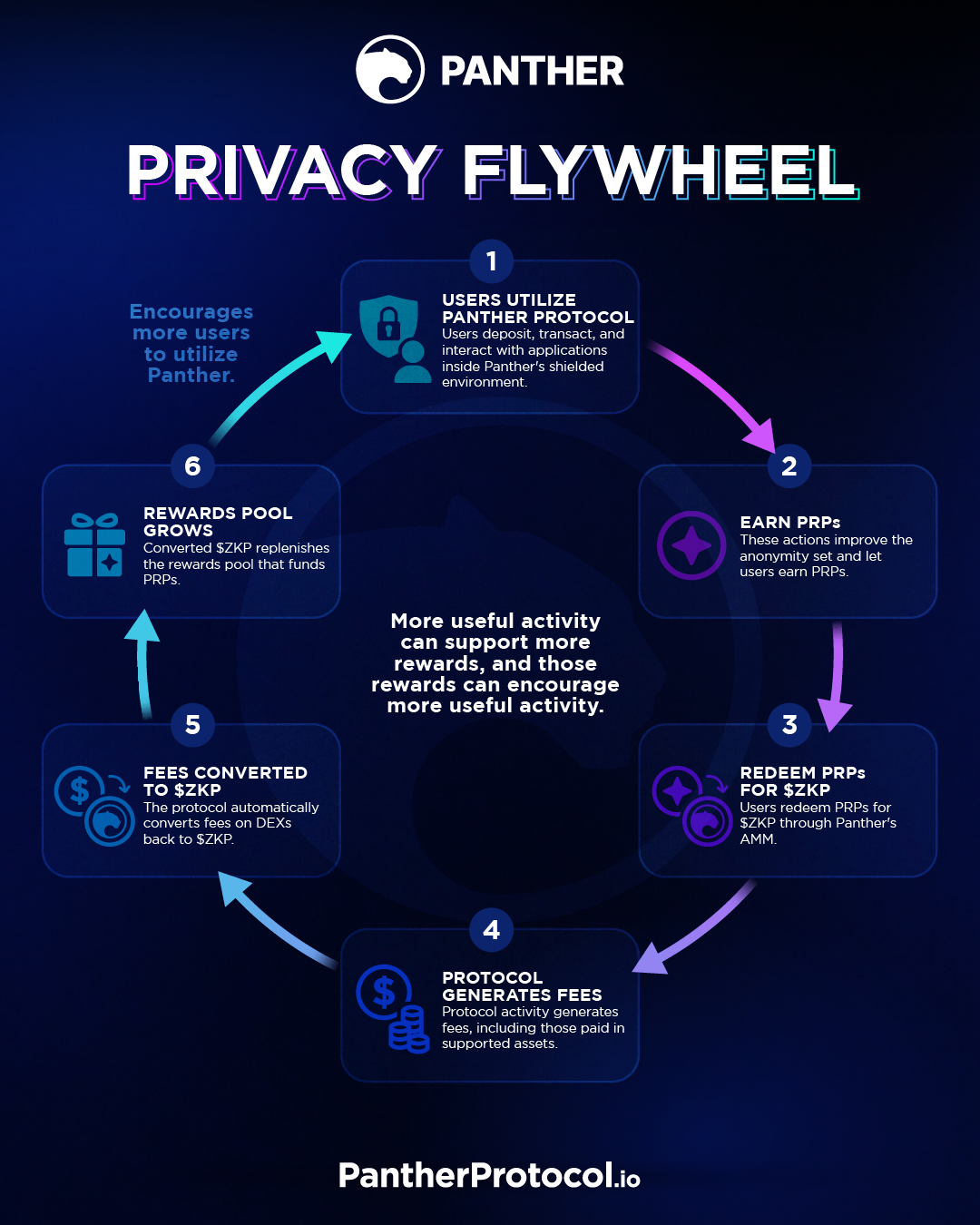
The key point is not that the usage of $ZKP must be permanent or identical across all Panther deployments but that the incentive system is built around a specific loop: privacy-set activity earns PRP -> PRPs redeem into $ZKP -> protocol fees help replenish the $ZKP-denominated reward infrastructure, and $ZKP functions as the economic asset around which the reward system is organized.
What Panther’s design aims to accomplish
Panther’s economic design aims to align incentives with the practical needs of the anonymity set. It rewards deposits because deposits increase pool depth. It rewards internal activity because activity makes the pool harder to analyze through simple timing correlations. It can reward the use of adaptors because private interaction with DeFi applications can make the shielded environment more useful than a passive holding pool.
It can also reward maintenance actions, such as AMM recharge functions, because the reward system itself needs to remain operational.
This is not a claim that economics alone creates privacy. The cryptography, implementation quality, supported assets, zone rules, transaction patterns, liquidity, and user behavior all matter. But economics can influence whether the system receives the kind of activity its privacy model depends on.
That is where Panther’s design is meaningfully differentiated. Tornado Cash showed that privacy-set contribution could be privately accounted for and redeemed through an AMM. Railgun shows how protocol fees can support governance/security incentives. Panther combines private activity rewards, PRP accounting, AMM-based redemption, and $ZKP reserves into a model specifically designed to encourage useful activity within the privacy environment.
A balanced approach to incentivizing the anonymity set
The strongest way to describe Panther’s advantage is not to say that other privacy protocols ignored incentives. They did not. Tornado Cash and Railgun both made important design choices around incentives, governance, and protocol economics. The better point is that Panther places the reward mechanism closer to the behavior that improves the shielded pool's anonymity set.
Instead of only rewarding governance participation, Panther can reward users for actions such as depositing, transacting, holding assets privately, or using private DeFi adaptors.
Panther separates reward accounting from redemption pricing. PRPs are earned according to DAO-set reward parameters and available reward budgets, while the amount of $ZKP received for redeemed PRPs is determined by the AMM’s reserve state rather than by a permanently fixed manual exchange rate.
Instead of treating the token as separate from the privacy infrastructure, Panther gives $ZKP a role inside the reward loop itself.
That is the productive role of $ZKP: it is the economic asset through which Panther turns anonymity-set contribution into redeemable value.
Conclusion
Privacy protocols face a practical problem: strong cryptography is not enough if the privacy set is small, inactive, or rarely used. A useful privacy system needs depth, activity, fresh inflows, and application-level reasons for users to remain inside the private environment.
Panther’s answer is to make those actions economically legible. Users earn PRPs for activity that supports the anonymity set. PRPs redeem into $ZKP through a reserve-based AMM. The redemption rate responds to reserve conditions and redemption demand rather than being fixed forever by governance. In addition, protocol fee flows can be recycled into $ZKP, helping connect real usage of the protocol to the reward infrastructure that supports PRP redemption.
This does not eliminate all challenges. Panther’s model still depends on real user adoption, careful parameter setting, sustainable reserve management, supported assets, and the design of each Zone. But it is a clear attempt to treat privacy as a network effect that requires its own incentive layer. $ZKP drives Panther’s privacy economy.
That is what makes Panther’s approach notable: it does not rely solely on users choosing privacy on principle. It tries to reward the actions that make privacy more useful in practice.
Try out Panther Protocol here: https://pantherdao.app/
To learn more about Panther Protocol, visit www.pantherprotocol.io