How Panther Protocol Shields Users from MEV: Privacy as a Powerful Defense

Table of Contents:
In Decentralized Finance (DeFi), Maximal Extractable Value (MEV) remains one of the most persistent challenges. Searchers and bots scan the public mempool, front-run profitable trades, execute sandwich attacks, and reorder transactions for profit, often at the expense of real users. This erodes trust, increases costs, exposes strategies, and worsens the overall UX in DeFi. Panther leverages Zero-Knowledge proofs to make critical transaction details confidential. Privacy becomes the primary defense against MEV.
Understanding MEV: The Cost of Transparency
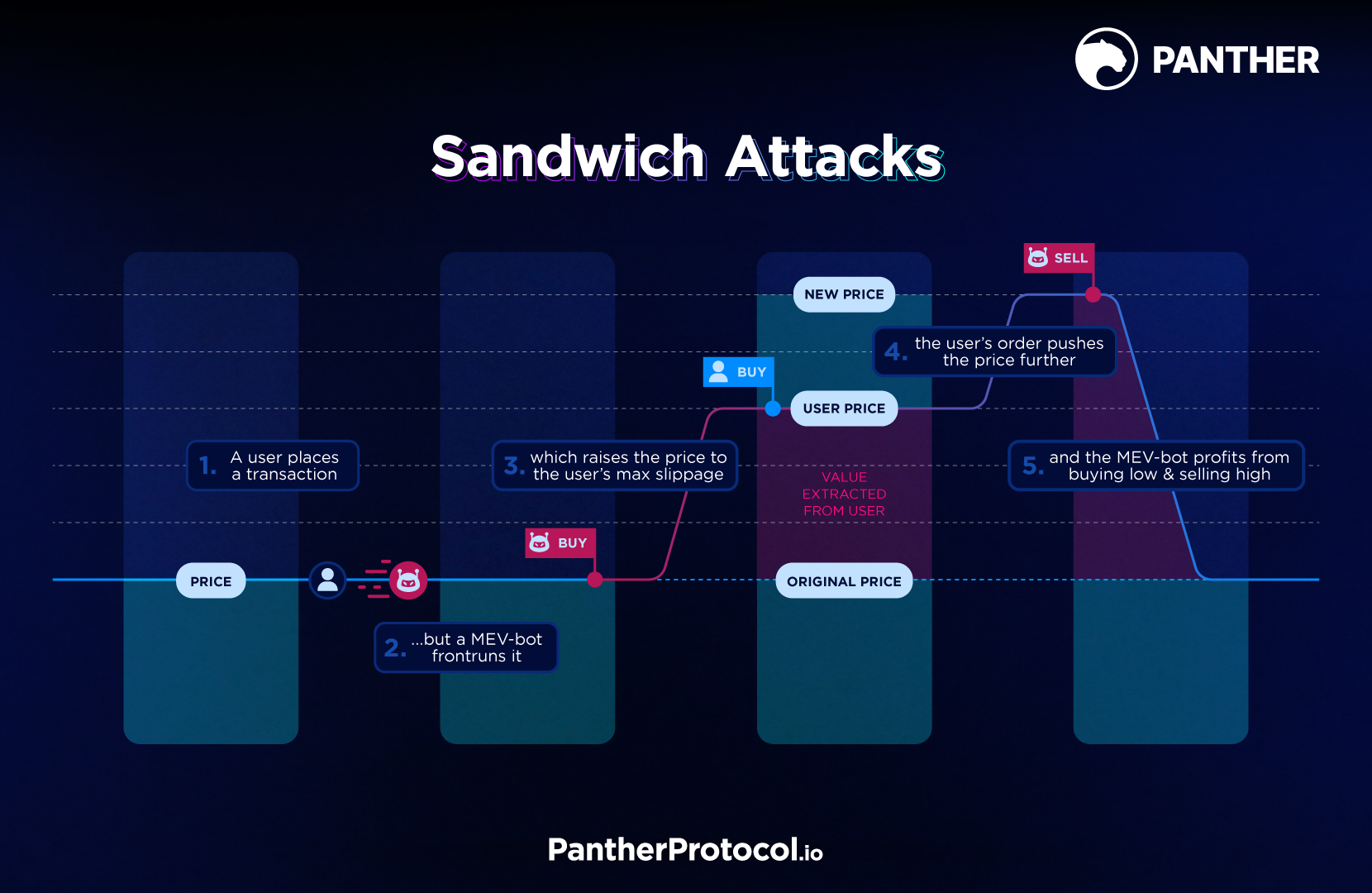
On public blockchains like Ethereum or Polygon, every pending transaction is visible in a shared mempool. Bots detect large swaps, arbitrage opportunities, or liquidations and insert their own transactions to exploit them:
- Sandwich attacks: A bot buys before a large purchase (pushing the price up) and sells after. Hence, the bot profits from the volatility caused by the user.
- Front-running: Copying and executing a profitable strategy ahead of the user.
- Back-running and other variants: Extracting value from oracle updates, liquidations, or NFT mints.
MEV generates billions in annual value for sophisticated actors while costing everyday users through worse execution prices and slippage. Mitigations like Flashbots or a very high TPS help, but don’t eliminate one of the core drivers of many forms of MEV: public visibility into intent, amounts, and counterparties.
While not all forms of MEV rely on public transaction visibility, reducing information leakage removes one of the most important sources of extractable value. Panther's confidential infrastructure is designed around that principle.
Panther’s Confidential infrastructure: Shielded Pools, Zones, and zSwap
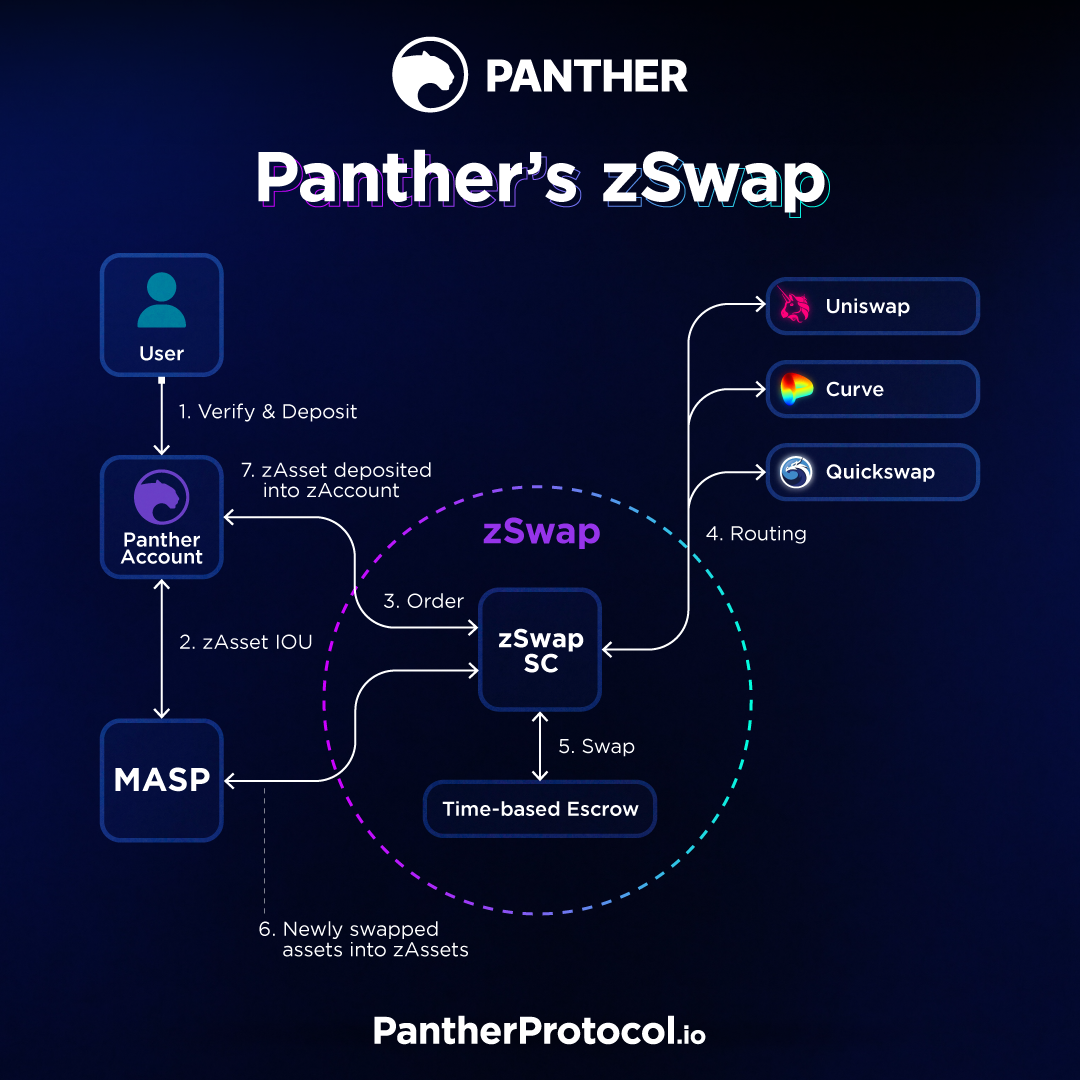
Panther's Multi-Asset Shielded Pools (MASPs) form the foundation of the protocol's confidential infrastructure. Users deposit supported assets into Panther's vaults and receive fully collateralized private representations, known as zAssets. These zAssets can then be transferred and used within the shielded environment without publicly revealing transaction details.
Transactions inside the shielded pool use:
- zk-SNARKs to prove validity (e.g., “I have sufficient balance”) without revealing amounts, senders, receivers, or links to external wallets.
- UTXO model with append-only Merkle trees for private state management.
- Nullifiers that prevent double-spending while maintaining unlinkability.
Because external observers see only cryptographic commitments and proofs, and not the underlying data, MEV bots lack the information needed to identify and exploit specific trades.
zSwap: Private Access to Public Liquidity
For users needing external DEX liquidity (Uniswap, QuickSwap, Curve, etc.), Panther’s zSwap functionality routes trades privately:
- The shielded balance initiates the swap.
- Stealth addresses and ZK proofs obscure origins and details.
- Panther minimizes the information exposed before and during execution, reducing opportunities for certain forms of MEV compared with directly trading from a public wallet.
Even when interacting with public protocols, the Panther Protocol minimizes information leakage compared to direct wallet-to-DEX trades.
While reducing opportunities for MEV is an important benefit, confidential execution also protects legitimate trading strategies and sensitive transaction information. This is particularly relevant for professional traders, treasury managers and institutions that may wish to avoid signaling large portfolio movements or exposing proprietary trading activity before execution.
Programmable Zones: Controlled Yet Confidential Environments
Panther’s Shielded Pools can be divided into Zones, which are logical partitions of shielded pool liquidity managed by operators, which may include regulated Virtual Asset Service Providers (VASPs), depending on the deployment. Each Zone can enforce custom rules (allowlisted assets/users, KYC attestations, transaction limits) while sharing the pool’s strong anonymity set:
- Operators manage permissioned Zones with known counterparties.
- Compliance tooling can support regulatory requirements while preserving privacy for other participants.
Additional Layers of Privacy Protection
- Growing anonymity set: More users and a more diverse set of assets in the pool make individual transactions harder to distinguish.
- Non-interactive transfers: zAccounts enable private peer-to-peer movement without revealing EOAs.
- Economic incentives: Panther Reward Points (PRPs) and the single-sided AMM encourage activity, strengthening privacy over time.
Why Confidentiality Matters for MEV Resistance
As DeFi matures and institutions allocate more capital on-chain, MEV protection becomes necessary for DeFi to scale. Panther improves the UX through its confidential infrastructure by delivering:
- Better execution prices.
- Strategy protection.
- Reduced systemic risks from MEV.
- Compliance tooling for operators.
Panther combines privacy-preserving technology with configurable AML and compliance tooling, enabling operators to implement risk-based compliance controls while preserving confidentiality and helping to minimize opportunities for MEV extraction.
Conclusion: Privacy Powers Fairer Markets
Panther Protocol demonstrates how confidential infrastructure can make DeFi more secure, efficient and accessible. By reducing unnecessary information leakage, shielded pools and zSwap help reduce opportunities for front-running and other forms of information-driven MEV, while also protecting legitimate trading strategies and sensitive transaction activity. As the protocol expands across different blockchains, Panther aims to provide a confidential infrastructure that supports fairer, more efficient on-chain markets for both individual users and professional market participants.
About Panther Protocol Foundation
Panther Protocol Foundation is a non-profit organization that supports the Panther ecosystem through research funding, open-source development grants and ecosystem initiatives.
The Foundation does not operate the protocol, host user interfaces, custody assets, execute transactions or provide financial services.
Users interact directly with blockchain smart contracts from their own wallets and remain responsible for their own activities and decisions.
For more information, visit www.panther.org
To learn more about Panther Protocol, visit www.pantherprotocol.io