Why Onchain Privacy Matters in the Age of AI


Table of Contents:
Public blockchains were designed for transparency. Every transaction, wallet interaction and asset movement can be viewed, analyzed, and stored indefinitely.
For years, this transparency was often seen as a feature. Today, advances in artificial intelligence are changing the equation.
AI has made blockchain analytics faster, cheaper and more powerful. Information that once required specialist tools and significant effort to analyze can now be processed at scale. Wallet activity can be clustered, patterns identified, and behavioral profiles built more efficiently than ever before.
As crypto moves toward mainstream adoption, privacy is no longer just a personal preference. It is becoming a prerequisite for individuals, institutions and businesses that want to participate in onchain ecosystems without exposing every aspect of their financial activity to the world.
Why Privacy Matters for DeFi
The promise of decentralized finance is open access to financial services. But open access does not necessarily require complete transparency.
In traditional finance, transaction histories, trading strategies, balances and counterparties are not published for anyone to inspect. In contrast, most blockchain activity is visible by default.
This creates several challenges.
Protecting Financial Confidentiality
Every onchain interaction contributes to a permanent public record. Traders, investors, businesses and institutions may not want competitors, counterparties or third parties analyzing their activity in real time.
As analytics tools become increasingly sophisticated, maintaining confidentiality becomes more difficult. Privacy infrastructure helps users decide what information they share and what information remains private.
Reducing Profiling and Wallet Targeting
Public wallet activity can be used to build detailed profiles of users, including transaction habits, asset holdings and behavioral patterns.
For high-value wallets, active traders and institutions, this visibility can create additional risks. Privacy-preserving infrastructure makes it more difficult to link activity, follow asset movements and build comprehensive profiles based on public blockchain data.
Supporting Real-World Adoption
Many organizations cannot operate effectively if every transaction, balance change and commercial relationship is visible to the public.
For decentralized finance to support broader adoption, users need tools that provide confidentiality while preserving the benefits of public blockchain infrastructure.
How Panther Helps
Panther Protocol is designed to provide configurable privacy for onchain activity.
Rather than requiring users to choose between complete transparency and complete opacity, Panther aims to give users greater control over how their onchain activity is exposed.
Using Zero-Knowledge proofs, Panther enables users to interact with privacy-preserving infrastructure while maintaining control of their assets and transactions.
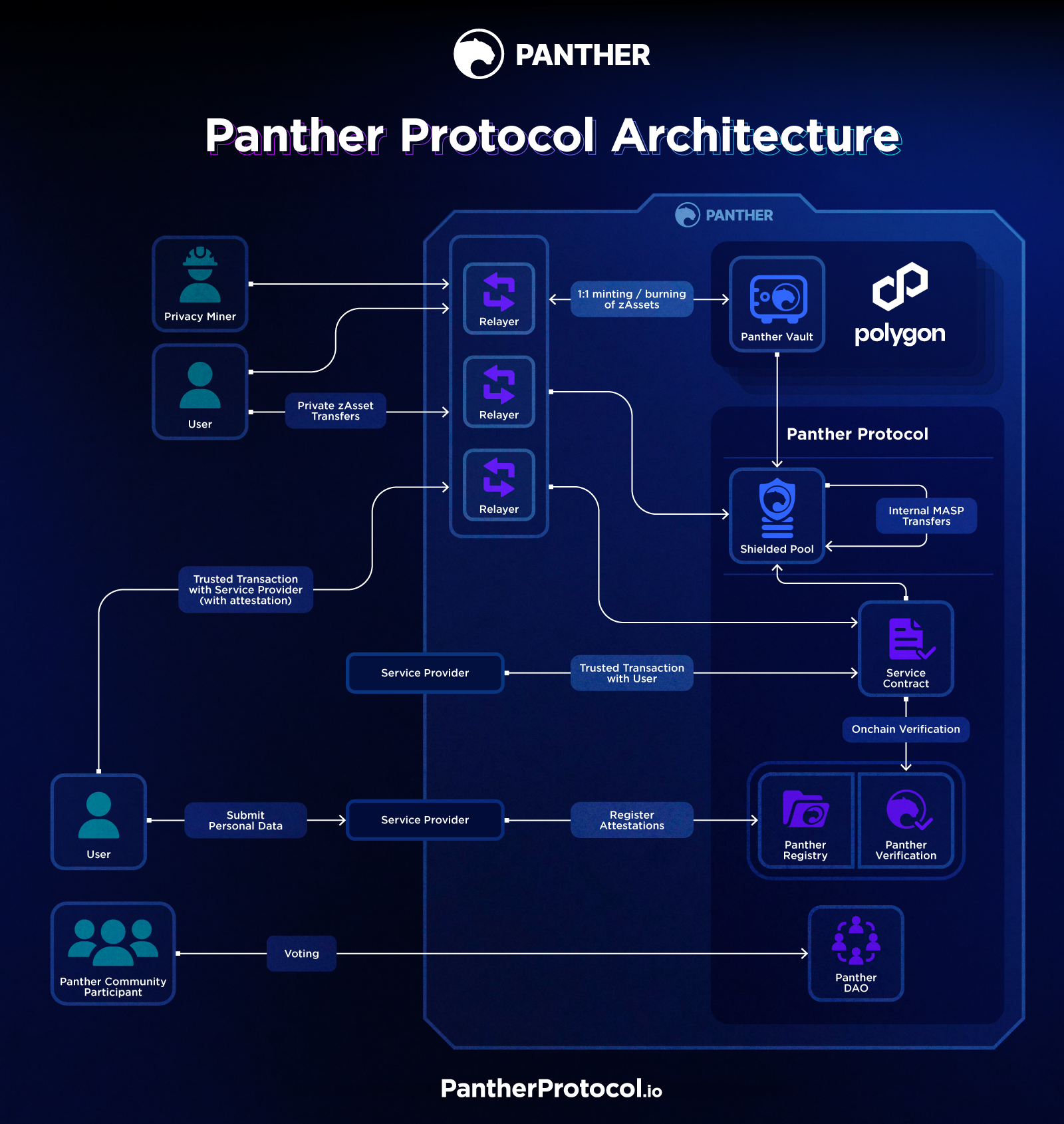
Multi-Asset Shielded Pools
Panther allows users to deposit supported assets into shielded pools and receive corresponding privacy-preserving representations of those assets.
Within the shielded environment, transactions can be conducted without exposing the same level of information that would typically be visible on a public blockchain.
This helps break the direct link between public wallet activity and subsequent transactions, making large-scale profiling and behavioral analysis more difficult.
Privacy-Preserving Architecture
Panther uses a UTXO-based model within its shielded environment to help reduce the ability of third parties to link transactions together.
Rather than exposing a single persistent transaction history to public observers, the architecture is designed to make blockchain analysis significantly more challenging.
Programmable Privacy Zones
Different users have different requirements.
Institutions, businesses and communities may wish to operate within environments that apply specific participation criteria, asset restrictions or operational rules.
Panther's Privacy Zones are intended to support configurable environments while allowing participants to benefit from the broader privacy set of the protocol.
User-Controlled Data
Privacy is not simply about hiding information. It is about controlling access to information.
Panther's architecture is designed around the principle that sensitive information should not be publicly exposed by default.
Identity verification and compliance-related processes can be performed by independent third-party providers without requiring personal information to be published onchain.
This approach helps reduce unnecessary disclosure while allowing ecosystem participants to build services that align with their own operational and regulatory requirements.
Privacy and AI Are Converging
The combination of transparent blockchains and increasingly capable AI systems is creating new challenges for digital privacy.
As analytics become more powerful, public blockchain data becomes easier to interpret, correlate and utilize at scale.
The question is no longer whether blockchain data can be analyzed. It is how much information users should be required to reveal in order to participate.
Privacy-enhancing technologies help restore balance by giving users greater control over their information while preserving the openness, security and composability that make public blockchains valuable.
As onchain ecosystems continue to mature, privacy is likely to become an essential part of blockchain infrastructure rather than an optional feature.
About Panther Protocol Foundation
Panther Protocol Foundation is a non-profit organization that supports the Panther ecosystem through research funding, open-source development grants and ecosystem initiatives.
The Foundation does not operate the protocol, host user interfaces, custody assets, execute transactions or provide financial services.
Users interact directly with blockchain smart contracts from their own wallets and remain responsible for their own activities and decisions.
For more information, visit www.panther.org
To learn more about Panther Protocol, visit www.pantherprotocol.io